Important: This information is provided for educational purposes. ESD protection requirements vary by facility and component specifications. Consult certified safety professionals for installation-specific guidance.
Analysis published by IEEE Innovation at Work demonstrates that ESD may account for up to 33% of semiconductor failures during manufacturing and handling. Devices pass initial quality checks yet fail prematurely in customer applications, making systematic protection essential.
This guide delivers actionable protocols grounded in IEC 61340 standards. You’ll find guidance for establishing compliant ESD Protected Areas, equipment selection frameworks, and verification methodologies that withstand audit scrutiny.
ESD protection essentials in 60 seconds
- ESD causes up to 33% of semiconductor failures, with discharge voltages as low as 100V destroying sensitive devices
- Systematic protection requires three integrated layers: antistatic packaging, personal grounding equipment, and verified EPA zones
- IEC 61340-5-1 and ANSI/ESD S20.20 form the dual foundation for compliant control programmes across industries
- Implementation success depends on facility-specific risk assessment, not generic equipment procurement
- Verification testing and documentation close the gap between installed infrastructure and maintained compliance
- Why electrostatic discharge threatens your sensitive equipment
- Essential materials and equipment for comprehensive protection
- Building your EPA: from assessment through verification
- Standards compliance: navigating IEC 61340 and industry requirements
- Common questions about ESD protection implementation
Why electrostatic discharge threatens your sensitive equipment
An assembly technician walking across standard flooring accumulates several thousand volts of static charge through friction, then handles a microprocessor rated for 1.2V operation. The resulting discharge—often imperceptible—can instantly damage gate oxide layers or junction structures. Devices exhibiting this latent damage typically pass functional testing yet experience significantly reduced operational lifespans.
Human perception of static discharge begins around 3,000V, whilst research demonstrates that discharge voltages as low as 100 volts can destroy modern semiconductor devices. This perception gap means countless damaging events occur without operator awareness, making systematic infrastructure protection essential.
Component replacement costs range from pence for passive devices to hundreds of pounds for complex assemblies. Production stoppages add labour costs and schedule delays. When latent damage escapes inspection, warranty claims multiply losses. Industry experts cited by IEEE Spectrum estimate ESD contributes to over 30% of semiconductor failures, translating to substantial annual losses for facilities handling sensitive components at volume.
Attention: Latent ESD damage represents a particularly insidious failure mode. Unlike catastrophic failures that trigger immediate rejection during quality control, latent damage degrades device reliability progressively. Components ship to customers, pass initial installation testing, then fail prematurely during operation—creating warranty costs, customer dissatisfaction, and potential safety implications depending on application criticality. Standard electrical testing rarely detects these microscopic defects until accelerated life testing or field deployment reveals the compromise.
Essential materials and equipment for comprehensive protection
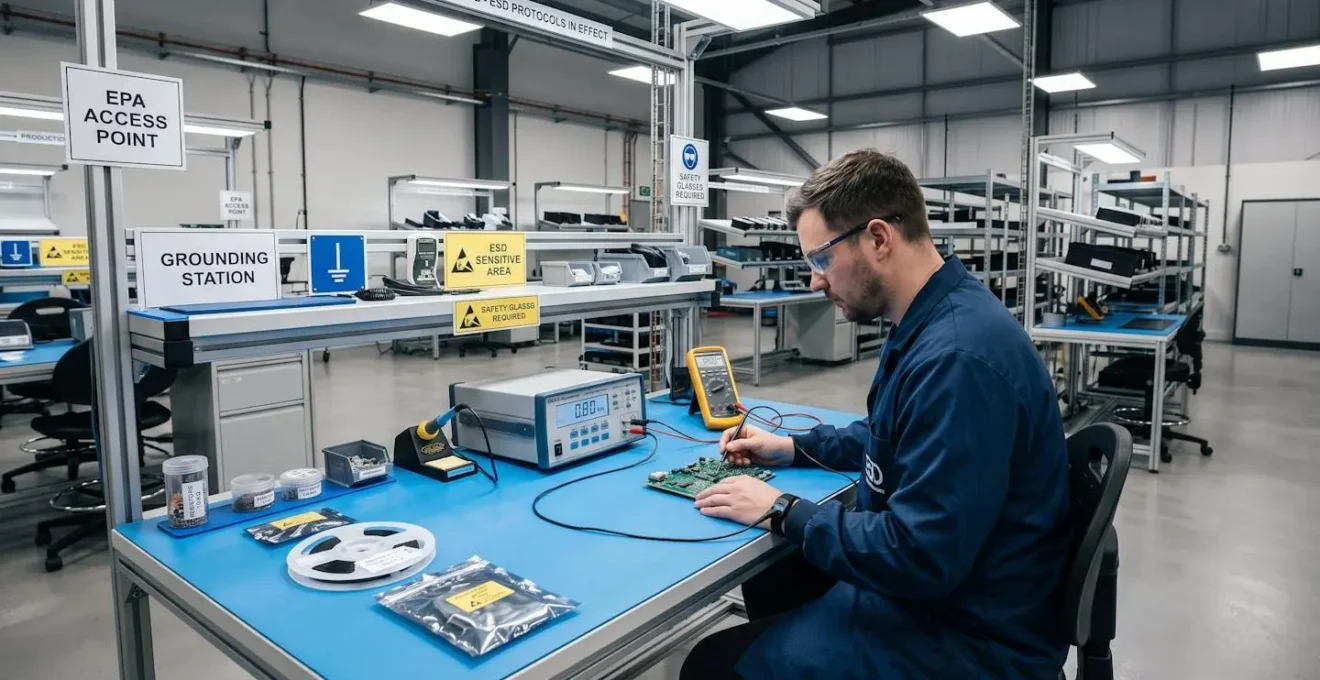
Effective ESD control operates through three integrated protection layers: containment systems that isolate charged objects from sensitive devices, personal grounding that continuously dissipates operator charge accumulation, and controlled work environments where all conductive and dissipative materials connect to common electrical ground. Each layer addresses distinct failure mechanisms; omitting any component creates vulnerability regardless of investment in the others.
Packaging materials form the first defensive perimeter. Shielding bags constructed from metallised films create a Faraday cage effect, blocking external electrostatic fields. These differ from pink antistatic bubble packaging, which prevents triboelectric charging but offers no field shielding. For moisture-sensitive components, barrier packaging adds aluminium layers controlling both humidity and ESD. Selecting appropriate packaging requires matching material properties to component sensitivity—an area where systematic procurement of ESD protection materials eliminates guesswork through certified specifications aligned to international standards.

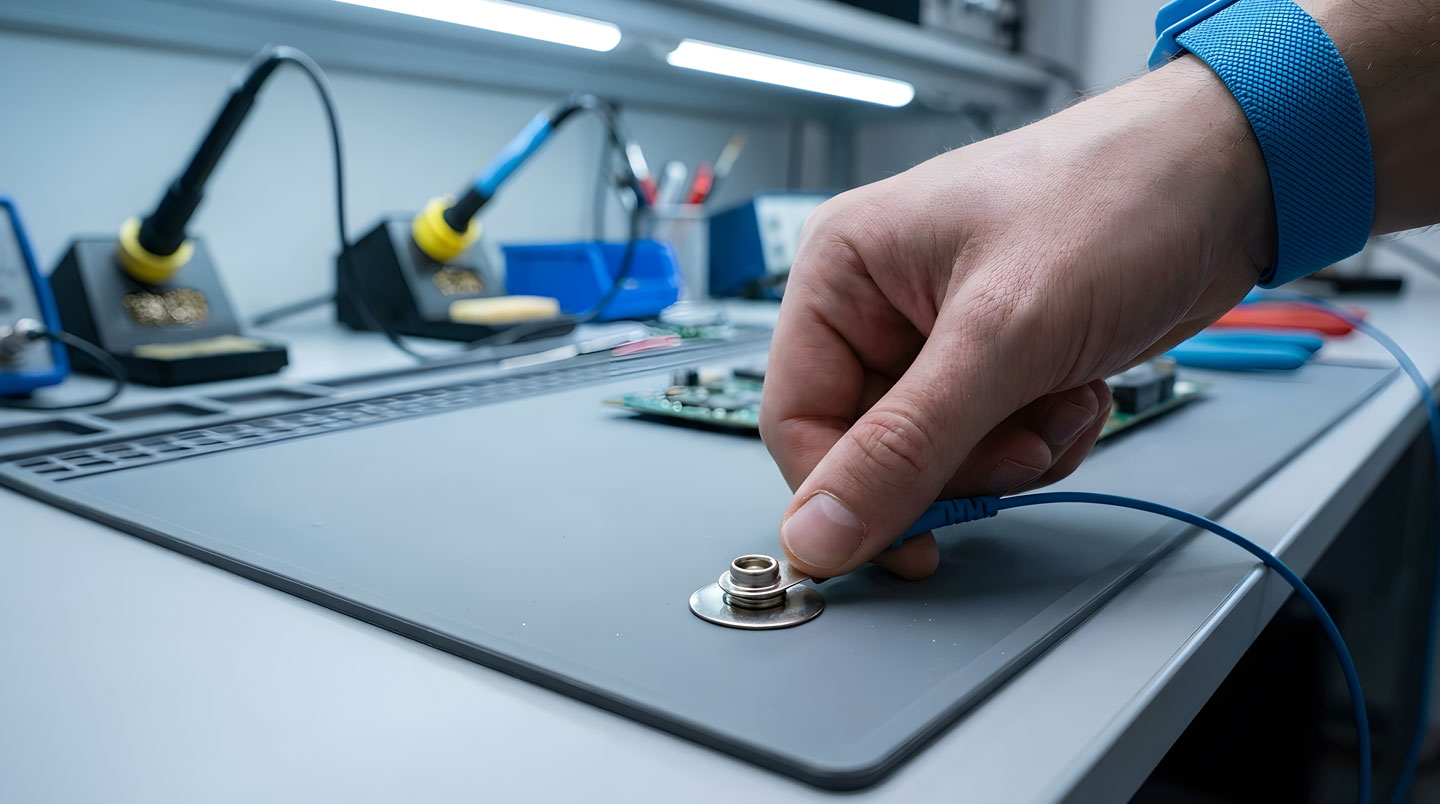
Personal grounding equipment maintains continuous electrical connection between operators and facility ground. Wrist straps with coiled cords and 1-megohm resistors provide reliable grounding for seated assembly work. Heel grounders offer mobility for personnel moving throughout EPA zones whilst maintaining grounding contact through conductive flooring. Both systems require daily verification testing—a non-negotiable requirement for documented compliance.
Workstation infrastructure converts standard benches into controlled environments. ESD mats provide dissipative work surfaces that drain charge from tools and components. These connect to common point ground through dedicated grounding hardware. Ionisers neutralise charge on insulating materials that cannot be grounded directly. Storage solutions must exhibit appropriate surface resistivity to prevent charge generation during handling.
- If handling HBM Class 0 devices (< 250V sensitivity):
Deploy full EPA infrastructure including ionisation, shielding packaging, and continuous wrist strap monitoring systems. Standard antistatic measures prove insufficient.
- If handling HBM Class 1 or 2 devices (250V–2,000V):
Implement verified EPA zones with personal grounding, conductive work surfaces, and appropriate packaging. This represents the baseline for modern semiconductor handling.
- If handling only robust passive components:
Basic antistatic packaging and grounded work surfaces may suffice, though formal risk assessment should validate this reduced approach before implementation.
Building your EPA: from assessment through verification
Establishing an ESD Protected Area follows a structured pathway from understanding risk exposure to documented verification. Skipping preliminary assessment or final validation creates gaps that audits will expose.
Conducting facility risk assessment and zone definition
Risk assessment identifies which devices require protection, where handling occurs, and what factors increase discharge probability. Catalogue component sensitivity classifications using manufacturer datasheets—devices typically carry HBM, CDM, or MM ratings defining damage thresholds. Map these against your process flow to determine protection requirements at each stage.
EPA boundaries must encompass all locations where unpackaged sensitive devices exist outside protective containers. Boundaries typically coincide with physical barriers—walls, partitions, or floor markings. Designating an entire facility as EPA proves impractical; focused zones around actual handling areas deliver equivalent protection with manageable infrastructure investment.
Installing grounding infrastructure and environmental controls
Common point grounding forms the foundation of EPA design. All conductive and dissipative materials—work surfaces, flooring, shelving, equipment chassis—must connect electrically to a dedicated grounding point that connects to verified facility ground. This creates equipotential bonding preventing voltage differences between objects. ESDA documentation emphasises that proper installation requires measuring resistance values between each grounded element and the common point, with acceptance criteria of less than 1 megohm for personnel groundings and less than 1×10⁹ ohms for work surfaces.
Environmental controls address atmospheric conditions influencing static generation and dissipation. Relative humidity between 45% and 65% supports charge dissipation, whilst levels below 30% dramatically increase triboelectric charging. Facilities in arid climates or heated environments may require humidification systems to maintain target ranges.
Verification testing and compliance documentation
Installation verification confirms deployed systems meet design specifications before use. Surface resistance testing validates that flooring, mats, and work surfaces fall within specified ranges—typically 1×10⁴ to 1×10⁹ ohms. Wrist strap and heel grounder testing ensures proper connection through the operator-to-ground path. Measurements must be recorded with date, location, equipment identification, and technician signature.
Ongoing verification maintains compliance as materials degrade and connections loosen. Standards recommend daily testing of personal grounding devices, with monthly or quarterly verification of fixed infrastructure. Establishing testing protocols during initial setup prevents comprehensive installation followed by monitoring neglect.
Critical implementation failures to avoid: Compliance audits typically reveal three systematic errors. First, incomplete grounding where individual elements (mats, shelving, or tool stands) remain electrically isolated despite residing within the designated EPA. Second, inadequate verification frequency—annual testing proves insufficient for personnel grounding equipment subject to daily wear and connector degradation. Third, reliance on visual inspection rather than measured verification, particularly for parameters like surface resistance that cannot be assessed without proper instrumentation. Each failure mode negates significant portions of protection infrastructure investment whilst creating false confidence in system adequacy.
The most frequent gap we observe during facility audits involves the disconnect between purchasing ESD equipment and implementing a comprehensive control programme. Organisations install wrist straps and mats yet fail to establish verification protocols, training programmes, or documented procedures. Equipment provides capability; programmes deliver consistent compliance.
Dr Sarah Mitchell, Certified ESD Control Coordinator and Industrial Safety Auditor
Standards compliance: navigating IEC 61340 and industry requirements
According to ESDA reference documentation, IEC 61340-5-1 and ANSI/ESD S20.20 establish parallel requirements for controlled manufacturing environments, with IEC 61340-5-1 adopted in the UK and Europe through the BS EN designation system. Both specify systematic approaches encompassing facility design, equipment selection, personnel training, and verification procedures rather than prescribing individual product specifications.
Secondary standards address specific domains. ANSI/ESD S6.1 covers wrist strap systems; ANSI/ESD S541 governs packaging materials. A third category establishes test methods for characterising material properties—surface resistance, charge decay time, and shielding effectiveness. This hierarchy clarifies that achieving compliance requires documented programmes demonstrating systematic implementation rather than simply purchasing certified materials.
| Industry Sector | Base Standard | Additional Requirements | Certification Pathway |
|---|---|---|---|
| General electronics | IEC 61340-5-1 / ANSI S20.20 | None mandatory | ESDA facility certification |
| Automotive electronics | IEC 61340-5-1 | IATF 16949 integration, enhanced traceability | Third-party audit + IATF certification |
| Aerospace and defence | ANSI/ESD S20.20 | AS9100 compliance, MIL-STD specifications | Industry-specific auditors + clearance requirements |
| Medical devices | IEC 61340-5-1 | ISO 13485 integration, FDA QSR alignment | ISO certification body + regulatory inspection |
Successful compliance emerges from treating standards as integrated systems. Facilities benefit from engaging expertise for industrial risks during planning phases, particularly when sector-specific requirements overlay base ESD standards. This prevents costly retrofitting when implementations overlook industry-specific documentation or verification requirements.
Important implementation considerations: ESD protection requirements vary significantly based on component sensitivity levels and manufacturing environment characteristics. This guide provides general best practices grounded in international standards but does not replace facility-specific risk assessment and compliance verification tailored to your operational context. Standards and regulations evolve continuously; always verify current versions of IEC 61340 series standards and any industry-specific requirements applicable to your sector before finalising implementation plans. Effective ESD protection demands comprehensive programme implementation encompassing infrastructure, procedures, training, and verification—not simply equipment procurement.
Explicit risks to consider: Inadequate ESD protection can cause latent component damage not immediately visible during quality inspection but reducing long-term device reliability in customer applications. Conversely, over-specification of unnecessary protection measures increases facility costs without proportional risk reduction benefit. Inconsistent procedural compliance—such as intermittent wrist strap use or irregular verification testing—can negate substantial investment in physical ESD infrastructure. Consult certified ESD control coordinators, accredited compliance assessors, or industry-specific regulatory bodies for facility-specific implementation guidance ensuring both adequate protection and resource-efficient design.
Common questions about ESD protection implementation
What budget should facilities allocate for initial EPA establishment?
A basic single-workstation EPA handling moderately sensitive devices typically requires £800–1,500 for essential equipment: grounding infrastructure, work surface mat, wrist straps, packaging materials, and verification instrumentation. Larger production environments may invest £5,000–15,000 for comprehensive setup including flooring, ionisation systems, and automated monitoring. These figures represent baseline infrastructure only. Ongoing costs for verification testing, training, consumables, and periodic replacement must factor into total budgeting. Protection investment should be compared against potential loss from a single batch of damaged components—which frequently exceeds total EPA setup costs.
How long does complete EPA implementation typically require from planning through verification?
A focused single-zone implementation generally requires 3–6 weeks: risk assessment and planning (1 week), equipment procurement (2–3 weeks), physical installation (3–5 days), and verification testing (2–3 days). Larger deployments may extend to 8–12 weeks. Standards recommend phased implementation for multi-zone facilities, enabling learning from initial experience before scaling. The most frequent timeline extension involves inadequate upfront planning—facilities beginning installation without completed risk assessment typically encounter repeated modifications and verification failures that double implementation duration.
Can facilities achieve adequate protection without formal certification to IEC 61340 or ANSI standards?
Facilities can implement robust ESD control without third-party certification—physical protection derives from proper infrastructure, procedures, and verification regardless of certification status. However, certification provides strategic advantages: independent validation, documented evidence for customer audits (particularly relevant for automotive or aerospace supply chains), and structured frameworks reducing implementation errors. Cost-benefit analysis generally favours certification for facilities serving industries with explicit customer requirements, whilst smaller operations may achieve adequate protection through standards-aligned implementation without formal certification. The critical requirement involves following standards-based methodology whether pursuing certification or not—improvised approaches consistently underperform systematic programmes.
What verification testing frequency do standards mandate for ongoing compliance?
Personal grounding devices require daily verification before use—a non-negotiable requirement for documented compliance. Work surface mats and flooring require monthly verification, whilst fixed infrastructure undergoes quarterly or semi-annual testing depending on exposure and stress. Packaging materials need verification only upon receipt. Environmental parameters require continuous or daily monitoring in controlled EPA zones. These frequencies reflect minimum compliance intervals; high-reliability environments often implement more frequent verification. Verification requirements frequently surprise managers accustomed to equipment-focused ESD control—purchasing and installing materials represents approximately 30% of total programme effort, with ongoing verification, training, and documentation consuming 70%.
How do facilities quantify return on investment for ESD protection programmes?
ROI frameworks compare programme costs against avoided losses. Estimate baseline exposure: monthly component volume × average component value × estimated ESD failure rate (30–33% of semiconductor failures). Subtract residual failure rate with protection (typically reduced 85–95%) to calculate monthly savings. Compare against annualised programme costs including infrastructure, verification, training, and maintenance. Most facilities achieve positive ROI within 6–18 months. However, calculations must include indirect costs: warranty claims, customer relationship damage, and production disruption often exceed component replacement costs by 3–5 times. Facilities serving safety-critical applications must factor liability exposure from field failures—a consideration typically justifying protection investment regardless of simple component cost calculations.
Essential implementation priorities for immediate action
- Begin with facility-specific risk assessment mapping component sensitivity to handling locations before equipment procurement
- Prioritise common point grounding infrastructure as the foundation—all subsequent protection measures depend on verified grounding
- Establish verification testing protocols during installation rather than as afterthought—compliance depends on documented measurement
- Treat ESD control as integrated programme requiring procedures, training, and sustained monitoring rather than one-time equipment purchase